
Buy-Side Quality of Earnings
You are not buying revenue. You are buying a number nobody has tested.
The Adjusted EBITDA in your LOI was assembled by the people getting paid at closing. We tie every dollar of it back to a bank statement, an invoice and a payroll register — before you wire, not after.
The 3 a.m. question
What if the numbers aren’t real?
Every buyer has the thought. Very few do anything about it. Move the sliders to your deal and see what the thought is actually worth.
You would overpay
Every $1 of untested earnings costs you $5.00 of purchase price. The error runs one direction, and it is never in your favour.
An untested number
Sellers present Adjusted EBITDA prepared by the people being paid at closing. In most lower middle market processes nothing has been tied to a bank statement.
Asymmetric error
A 20% overstatement on a $4mm number is not $800k of pain. At 5.0x it is $4mm of purchase price, funded with your equity and your debt.
Recourse expires
Escrow releases. Reps survive twelve to eighteen months. The seller has already been paid. Discovery in month four is not a remedy.
You sign personally
Your lender takes a lien. Your investors take a board seat. You take a personal guarantee. Senior debt is sized off verified earnings, so the question gets asked either way.
Why Isagani Yorke
We sit on the other side of this table for a living.
Diligence, pricing discipline, and a controller who already knows the company on day one.

We represent sophisticated sellers, so we know the tricks.
We are M&A professionals, CPAs and former institutional finance people who have run transaction advisory for buyers and for sellers. We know where a set of books gets dressed up, because we have watched the tricks work — and we know which of them actually move your price.
Buy-side and sell-side experience · CPA-credentialed
Lower middle market pricing, deliberately.
We are built for lower middle market deals, not billed like a national accounting firm. Buyers here absorb every dollar of deal cost out of pocket, and too many deals break before close. We price aggressively rather than gouge on scope, because a QoE nobody can afford protects nobody.
Fixed fee, quoted before you engage · no national-firm rate
We stay past close.
Bookkeeping and fractional controller work from day one. We already know the company intimately from the QoE, so there is no second team to bring up to speed, no data request sent twice, and no learning curve running on your clock during the only ninety days that set the tone.
Bookkeeping live from day one post-close
What the untrained eye misses
Drag the line across the add-back schedule.
This is the part of diligence that decides your price. On the left is what a seller hands you. On the right is what a CPA can actually defend in front of your lender. Illustrative, drawn from the work we do every week.
Five adjustments. $800,000 of EBITDA. $4,000,000 of purchase price at a 5.0x multiple — and the one add-back that was real, we signed off on.
Built for the way you buy
Nobody in this market is buying with house money.
A “Large Financial Sponsor” with a committed fund can absorb a bad number. You cannot. That is exactly why the QoE is the highest-leverage document in your deal budget.

Independent Sponsors
You are raising equity deal by deal, and the first thing a capital partner asks for is the third-party QoE. Walking into that conversation with one already done is the difference between a re-trade and a close.
Arrive with the number already defendedSearch Funds
Your investors voted on a thesis, not on a trial balance. An independent QoE is what turns a signed LOI into funded capital without a second round of questions from twelve different people.
One document, twelve investors satisfiedSelf-Funded & SBA Buyers
There is no fund behind you to absorb a miss, and your name is on the guarantee. Your SBA or mezzanine lender will size the debt off verified earnings regardless, so it may as well be your report and your timeline.
Your report, your timeline, your leverageFinancial Advisors
You are advising the buyer, and your credibility rides on the number in the model. We work quietly alongside you — independent, CPA-credentialed and conflict-free — so every dollar of earnings your client is paying for is tied to a source document before the wire.
Independent support behind your adviceFamily Office
You are deploying family capital into a business you intend to hold for a generation, not a fund cycle. There is no LP to absorb the miss and no exit clock to bail you out, so the earnings number has to be documented well enough that whoever inherits the file can still trust it.
Permanent capital deserves permanent proofPrivate Equity
Your fund has a committed pool and an investment committee that expects a defended number, not a schedule the seller assembled. We run confirmatory diligence on a platform or a bolt-on at lower middle market speed, and we write it so your IC and your lender can both underwrite it.
IC-ready diligence at deal speedScope of work
Three deliverables.
Every engagement produces all three. Fixed scope, fixed fee, five to six weeks.
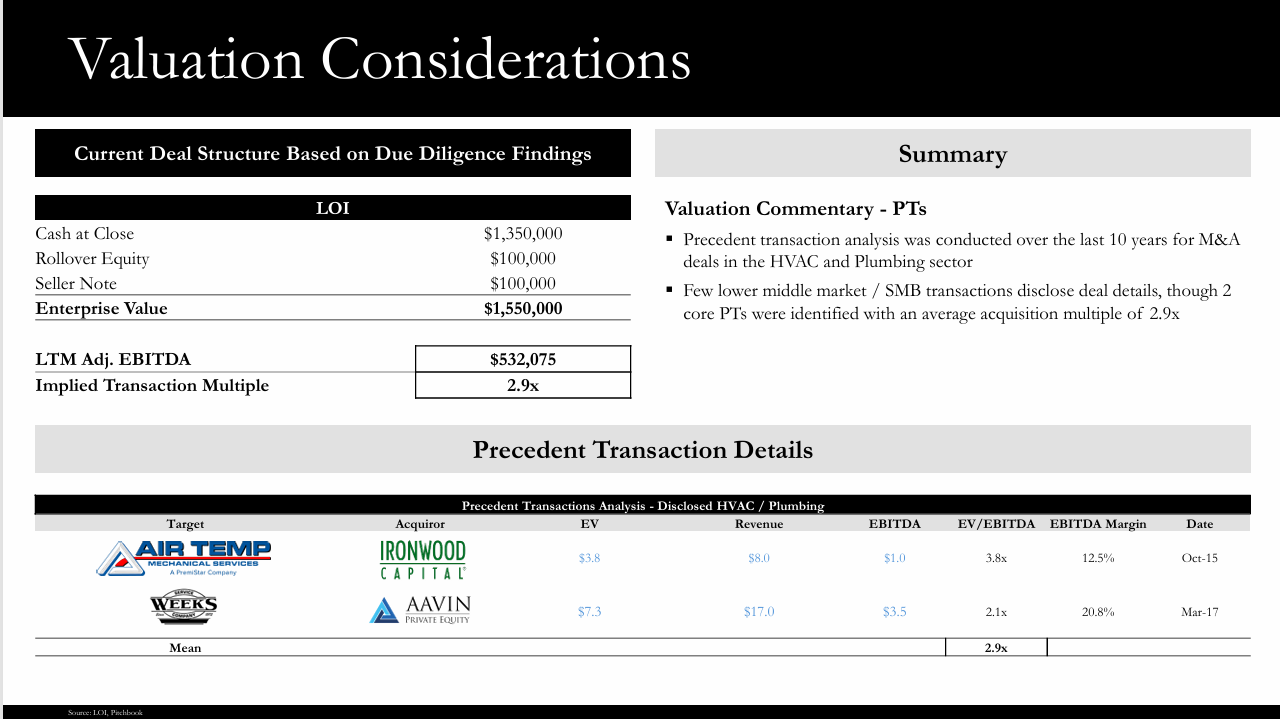
The full evidentiary record. Every schedule, every tie-out, every source reference — the file your lender and your investment committee will actually test.
- Monthly P&L, balance sheet and cash flow, FY2022 through LTM
- Adjusted EBITDA build with support behind every adjustment
- Proof of cash — revenue tied to bank deposits, by month
- Revenue by customer, product and channel
- Net working capital trend and a proposed peg
- AR / AP aging, inventory roll and reserve testing
- Debt-like items and off-balance-sheet commitments
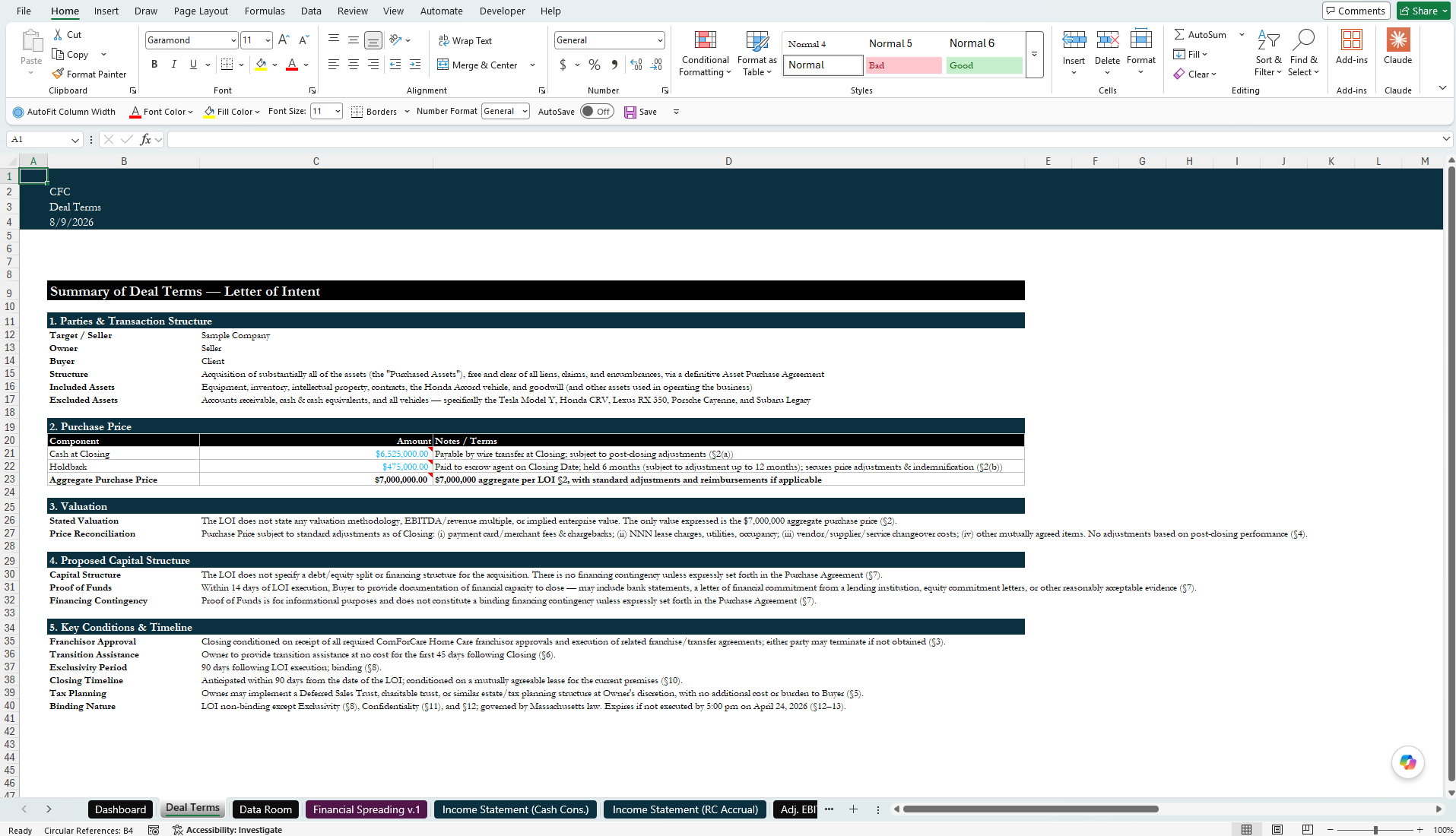
The version you can put in front of the seller. Clean, defensible, free of the working papers, and easy to walk through in a room.
- Executive summary and key findings
- Adjusted EBITDA bridge with the rationale for each item
- Quality of revenue and customer concentration
- Proof of cash summary
- Working capital peg recommendation
- Risks, watch items and recommended reps
- A one-page conclusion for your investment committee
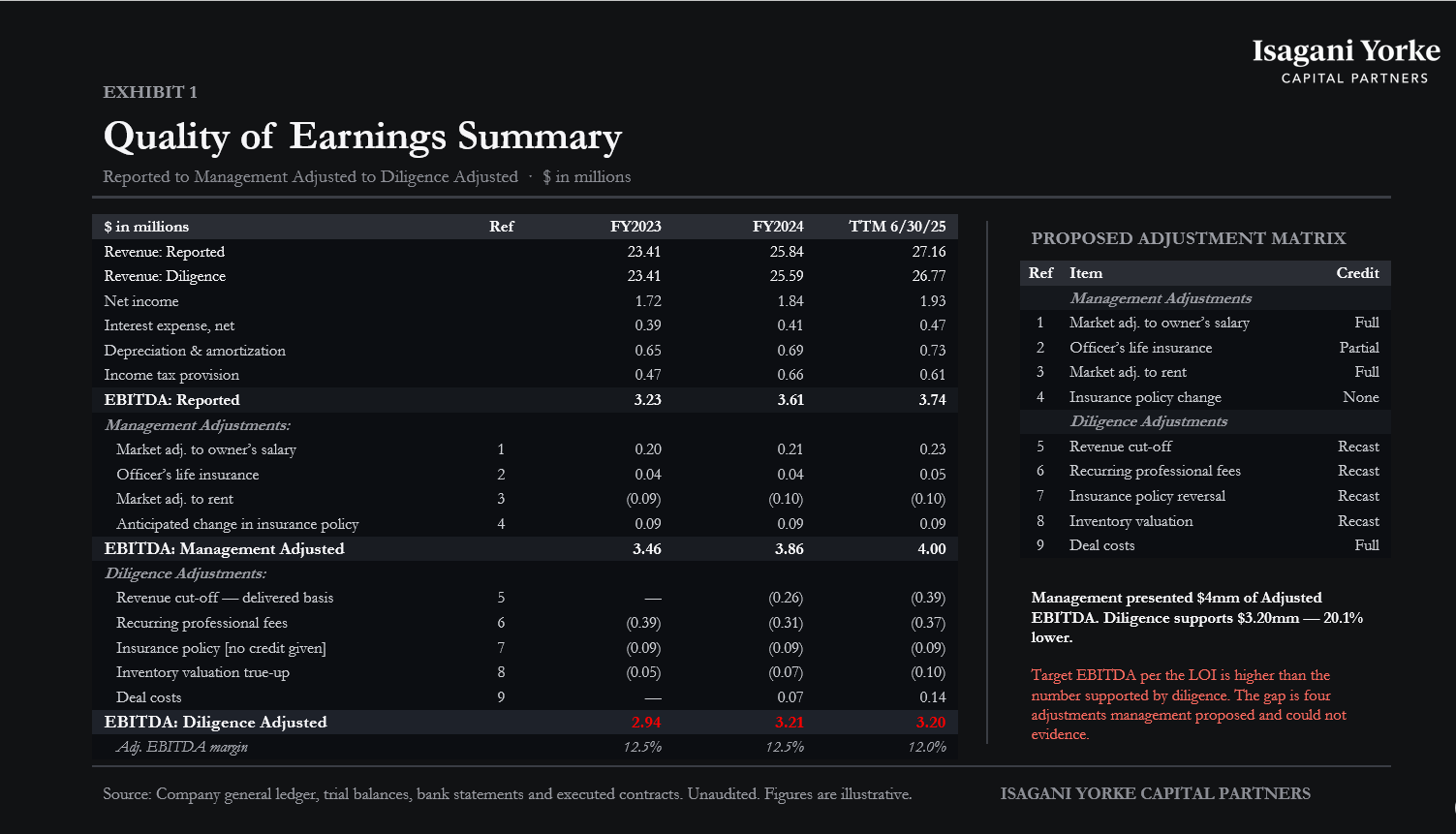
What the verified earnings are actually worth — and whether the price on the LOI sits inside a range you can defend.
- Selected public comparables, size- and liquidity-adjusted
- Precedent transactions at comparable scale
- Implied enterprise value on verified Adj. EBITDA
- Supportable Adj. EBITDA multiple range
- Sensitivity — purchase price per turn of multiple
- A recommended walk-away price
- Financing capacity at the verified number
After the wire
The first ninety days are the loudest.
The seller is gone, the controller may be too, and the lender wants a reporting package. Most QoE providers hand you a PDF and disappear. We are already inside the company.
Bank feeds, payroll, AP and AR are live in your entity on the first morning. The chart of accounts carries straight over from the QoE, so the reporting you underwrote the deal on is the reporting you actually get. No blank slate, no six weeks of catch-up.
We book the opening balance sheet and run the working capital true-up against the peg we recommended in diligence — the same team, the same schedules, the same numbers. Post-closing adjustments are argued from a file we built, not one we are reading for the first time.
Your first monthly close on accrual GAAP, plus the covenant compliance and lender package in the format your bank asked for. Month one is when a new owner either earns the lender’s confidence or spends the next year explaining themselves.
Budget versus actual against the model the deal was underwritten on. You find out in month three, not month twelve, whether the earnings you bought are the earnings you own — and there is still time to do something about it.
Engage us
Sign it. Wire it. Then sleep.
Send us the LOI and the data room index. We will come back with what we would test, what it costs, and how fast — before you engage us and before the clock on your exclusivity runs out.
Common questions
Quality of Earnings FAQ
What is a Quality of Earnings (QoE) report?
A Quality of Earnings report is an independent analysis that tests whether a target company’s Adjusted EBITDA is real. Isagani Yorke ties every dollar back to bank statements, invoices and payroll registers, rebuilds the books to accrual GAAP, and separates add-backs a CPA can defend from add-backs that will not survive a lender’s review.
Why does a buyer need a QoE before closing?
Adjusted EBITDA in a letter of intent is usually prepared by the people getting paid at closing. The error runs one direction. On a $4 million reported EBITDA at a 5.0x multiple, a 20% overstatement in the add-backs is roughly $4 million of purchase price funded with your equity and your debt. Escrow releases and reps typically survive only twelve to eighteen months, so discovering the problem after closing is not a remedy.
Who uses Isagani Yorke for buy-side QoE work?
Independent sponsors, search funds, self-funded ETA buyers and family offices acquiring lower middle market companies.
How much does a Quality of Earnings report cost?
Isagani Yorke quotes a fixed fee before you engage and prices deliberately for the lower middle market rather than at national accounting firm rates. Buyers in this market absorb deal costs out of pocket, and a QoE nobody can afford protects nobody.
What does a QoE typically uncover?
Common findings include owner compensation above market that has to be repriced at the salary of the general manager you will actually hire, so-called one-time legal or settlement costs that recurred in three of the last four years, personal auto, travel and membership expenses, and channel-fill stocking orders that never reorder. Genuinely non-recurring items such as an ERP implementation are supported and agreed.
Do you stay involved after the deal closes?
Yes. Isagani Yorke provides bookkeeping and fractional controller work from day one post-close. Because the same team ran the QoE, there is no second team to bring up to speed during the first ninety days.
Do you also work on the sell side?
Yes. Isagani Yorke represents sophisticated sellers through sell-side M&A advisory, which is exactly why the firm knows where a set of books gets dressed up and which adjustments actually move price.